Wednesday, April 8, 2009

66% of financial institutions fail to use their website's home page to tackle economic crisis.

“The majority of financial services companies - 66% - have been silent recently when it comes to communicating about the troublesome economy on their corporate Web site home pages” reports Weber Shandwick in an April 8th news release. The global public relations firm looked at a diverse segment of 55 U.S. and European/EMEA financial services companies including investment firms, commercial banks and financial data service firms. They tracked the organizations weekly since mid-October to determine their reactions as the economic news worsened. The study covered a five-month period.

“Since corporate home pages are a prime gateway to a company’s positioning, messaging and reputation, we examined them to determine how an industry under intense scrutiny rises to the challenge of building trust in tough times,” noted Barb Iverson, president of Weber Shandwick’s financial services industry practice group in the news release. “It is not enough for leading financial services companies to communicate only in good times.” She went on to urge financial services organizations to use their low cost, high impact home pages in communicating with customers and investors.

Surprisingly the European institutions studied communicated earlier on their home pages about the crisis than did their American counterparts. U.S. firms eventually caught up and surpassed their European peer sin home page communications.

Only 24% (in Feb. 2009) and 13% (in mid-Oct. 2008) linked to a message from a CEO/Chairman. Weber Shandwick reported that when these same execs were used on home pages, they helped “humanize the crisis and put a face on the company.”

Iverson noted in the release that “for many, the Web sites of these financial services companies are one of the first places that customers, investors and others go to in search of information and reassurance.”

Home page recommendations.
Incorporate the following into home page messages, recommends Weber Shandwick:
  • Explain unfamiliar financial terms and add hotline numbers, contact names & photos, as well as FAQs
  • Convey empathy in messages, as well as acknowledge customers’ confusion, concerns and loss of trust
  • Use social media tools such as podcasts, Webcasts, blogs and customer discussion forums in an attempt to make relationships more personal and interactive

The release featured additional stats and charts illustrating the agency’s findings.

The message for community banks.
While the sites studied were of Fortune 500 firms, smaller financial institutions can learn from the Weber Shandwick study. We know that all financial consumers, whether they are affiliated with a troubled institution or not, are concerned and fearful. The financial climate is not business as usual. And, smaller bank marketing departments are not immune to the fallout of the current economic situation. All financial institutions need to step up to the plate and to the challenge of relating to your customers. Your home page is the face of your institution. . . in good times and bad. And from our own observations working in financial communications, we’ve learned that the President’s Message is valuable real estate for your bank’s marketing. Mesh the two and you’ll forge a strong link with your consumer.

Related articles in Bank Marketing:
Ohio community banker talks “tough” on his website.

How do you combat negative headlines?

What can the “President’s Message” do for your marketing?

Fifth Third “dreams” of quelling consumers concerns.

Readers & employees respond to Wells Fargo “Las Vegas” blog post.

Tuesday, April 7, 2009

A superhuman marketing resource. . .
your branch manager.

Community banks have a secret weapon that larger banks cannot disarm. It’s the local branch manager. . . your Superman or Wonder Woman. He or she is usually a pillar of the community, a friendly loan officer and a trusted investment advisor all rolled into one dynamic personality. . .or you hope they have that added charisma. Some larger banks have done away with branch managers altogether and others are charging fees just to interact with a teller. Therefore, that affable manager can go a long way to market your bank and solidify your brand.

In 2007 Booz Allen Hamilton, a strategy and technology consulting firm, studied over 4,000 bank branches. The researchers identified the traits of top-performing bank managers. Those bank managers are. . .

1. Willing to be held accountable for both their success and failures
2. Proud of their bank, branch and employees
3. Creative in coming up with new ways to drive business
4. Driven to succeed and motivated by their branch’s success, not just their own salary and bonus packages
5. Confident in their ability to meet their goals
6. Typically hold an integrated view of all aspects of their business – sales, service, people, core operations. . . in other words, they run their branches as if they were their own businesses

Sounds like the perfect person who can personify your bank’s brand!

These traits bring in the clients, too.
Booz Allen found that the best branch managers are worth between $500,000 and $1 million in incremental revenue to the bank. And branch managers who settle in at an office tend to do better than those who are transferred. According to the study, branches with managers who have stayed put or who have moved only once enjoyed an average growth in deposits of 13.2 percent, whereas those with managers who have transferred to new positions more than five times had an increase of just 3.2 percent.

What’s in the psyche of the perfect community bank manager?
If you have a bank manager who sees himself or herself as a “town mayor”, you definitely have an asset. This person identifies strongly with the bank and the community rather than the overall organization. Maximizing the branch’s performance and the communities’ ability to prosper ranks high on this manager’s list of goals. This type of manager also has few ambitions to move beyond branch manager. They’ve found their niche.

Keep them in the loop & you’ll have a marketing ally.
While this person is a natural for promoting your bank’s brand and message, they shouldn’t be left in the dark as far as your marketing goals. The Booz Allen study noted that well-trained branch managers produce significantly higher customer-service and customer-satisfaction scores. Keep them in your marketing loop. Play off their strengths. Keep them happy by letting them interact with the community. In fact, encourage it. Your manager already identifies with the bank and the community. Give them the ammunition to continue to spread your message and they’ll become your bank marketing ally.

Monday, March 16, 2009

Ohio community banker talks “tough”
on his website.

While other banks were issuing letters and written statements about the state of their financial institutions, Bill Carr, president and CEO of Liberty National Bank, decided to literally roll up his shirt-sleeves and talk to the public. Carr is featured in two video podcasts which appear on his bank’s website. And, his message isn’t buried deep within the site. It’s front and center on the homepage. When accessed, the podcasts appear as a pop-up on the site.

While I’ve seen other bank presidents give video presentations on their websites, I prefer the genuine appeal of this one. First, this is a community bank with only 5 offices located in central Ohio. They can’t rely on slick, expensive videography. Second, Carr’s content is quite compelling. Rather than give the perfunctory, “we’re just fine” spiel, the president and CEO of this bank with $192 million in assets gives a tough and frank assessment of the economy. He hits the topic of subprime mortgages head on and reflects on their effect on community banking. This 40-year bank veteran addresses cost -cutting measures the bank intends to pursue including e-services (online statements), but pledges to retain employees. Carr even remarks on the new administration in Washington, D.C. His podcast is definitely a refreshing look at the entire banking situation. Because he is so honest, the customer definitely feels confident about Liberty National.

“Even at our shareholder meetings, he pretty much tells it like it is,” explained Heather Cox, Liberty National’s assistant vice president of marketing in an interview about Carr’s style.

Why should community banks consider
presidential podcasts?

Through my work with e-newsletters for our clients, we know that the President’s Message
garners the most readership each time these newsletters are broadcast. In fact, I’ve done a post on the importance of the President’s Letter, entitled “What can the ‘President’s Message’ do for your marketing?” And, I’ve encouraged bank marketing execs to take advantage of this prime real estate in their communications efforts. Liberty National has taken the President’s Message to a new and impressive level. And, I applaud this community bank for their ingenuity.

Podcasts supported with traditional media.
Rather than just let the podcast stand on its own merit, Cox supported the online video with news releases, newspaper ads and radio spots. The traditional marketing efforts helped drive traffic to the podcasts. Cox reports that the 1st video in the 2-part series received appox. 400 hits in February alone.

An advertising consultant produced the two podcasts for the bank’s marketing department. Each podcast is roughly 3 minutes long. . . a nice, concise length that keeps the viewer engaged. Rather than an interviewer quizzing the president or a continuous monologue, the presentation is broken by a couple of “fades to black” on which a question is posed to the exec.

The Liberty National podcast ends with Carr informing viewers that he will be retiring this summer. Let’s hope his successor keeps up the “talk”.

Monday, March 9, 2009

Using altruism to draw consumers
to your social networking sites.

A few posts ago, I blogged about how Dairy Queen was incenting bloggers to write about their new menu by awarding the first 250 to a $5 gift card. Now, author Tim Ferriss is encouraging people to “follow” him on Twitter, the fast-growing 140-character microblog. Billed as the “Tweet to Beat: Paying $3 per Twitter Follower”, Ferriss notes that he and an anonymous matching donor will give the funds to high-need schools in the U.S. via DonorsChoose.org Through this altruistic approach, Ferriss is sure to gain continued PR for his book and gain popularity in search engine rankings. . . all due to links connecting to his website and blog. He even provides readers with the appropriate links to use to direct others to his sites. Ferriss, who started the promotion at approx. 22,500 followers (those who sign-on to watch what he writes or “tweets”) will cap it at 50,000. The author of the NY Times bestseller, The 4-Hour Work Week, has set up his challenge with rules, regs and deadlines.

This is definitely an interesting approach to fundraising, public relations and social networking media. Simply it encapsulates all three in one tight package.

How can bank marketing executives use this same approach?
If you don’t already have a blog, FaceBook or Twitter presence, now is the time to consider one. Some time down the road, it will be essential to add these forms of social networking media to your marketing mix. Your younger consumers will demand it. And, you might be surprised how many of your “older” business and retail clientele is already dabbling with it. Starting now you can get your feet wet and experiment before your competition becomes adept at the increasingly popular media. A similar campaign from your bank marketing department would be a great driver to your social networking site. You’re introducing them to your new form of communication and identifying yourself as a community activist. Plus, you’ll be getting your employees backing that new bank promotional tool.

Many banks, especially community banks, are involved with altruistic endeavors in their various locales. But often times, the support is scatter-shot. . . giving to many different charities. I have recommend in the past that community banks choose one major charity . . . at least for the year. . . and commit to it. In effect, “branding” their bank with that charity. It could be the local fire department, an animal shelter or. . . . a tie-in to a financial product or service (supporting a military platoon which co-insides with your SBA Patriot Express program).

In the meantime, sign-on to Ferriss’ campaign, see how social networking works and help out a worthy cause.

Thursday, March 5, 2009

Talk about transparency. . . YES Bank displays its diversity. . . graphically.

In preparing various marketing materials for my clients, I’m instructed by their compliance departments to include diverse clientele and employees. In other words, a microcosm of our society. No problem with that. Mumbai-based YES Bank (which I introduced in my last post) has found a unique way to show its workforce profile. . . AND build its brand. The Indian financial institution boldly announces its “diversity” of “human capital” with a series of graphs covering an entire webpage.

In fact, their reference to “human capital” seems so apropos for this financial institution. The bank uses it to define their entire HR section (a fairly good-sized section at that) of their website. The term isn’t new. It was first defined by Adam Smith, an economist in the 1700s.

Building its brand around its workforce.
YES Bank has a reason for defining its workforce graphically. Apparently the bank is building its brand around the quality of its employees. Their stated objectives include:

- To build a strong employer brand.
- To attain a preferred employer status in the Banking and Financial Services industry.
- To ensure that the Bank is able to attract, engage and retain high quality human capital for its long-term success.

And, YES Bank seems to be achieving their branding goal. According to EECH – the largest source of management case studies in the world, YES Bank has established a strong employer brand and projects itself as an 'aspirational' employer in the Indian banking sector. EECH notes that the 200-branch bank has “differentiated itself from its competitors with its unique 'knowledge banking' approach and its emphasis on human capital.”

The bank has outlined a number of impressive employee programs including entrepreneur and mentoring programs. And, they’ve earned their stripes with the “Continuous Innovation in HR Strategy” Award.

What does all of this have to do with Bank Marketing in the U.S.?
While Americans may see the Indian bank’s “diversity” as a little lopsided, you must remember that you’re dealing with a different culture. But, there is a message here for financial marketers. First, YES is defining its brand around its employees. Their graphic approach drives that point home and works for them. It’s much more direct than the typical “we have great service” claim. And, second, your bank marketing (no matter what your brand) is only as good as your employees. . . i.e.,the knowledge and service they put forth. On the surface, YES Bank receives an affirmative grade on both fronts.

Wednesday, March 4, 2009

YES BANK gets a big “yes”
from a former U.S. President.

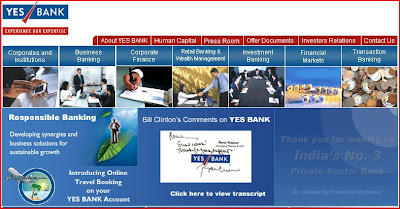
I’d call it a pretty good marketing coup when a bank has an actual endorsement by a former President of the United States on its website’s homepage. And, that what this Indian bank, aptly named YES BANK, achieved. I don’t care what your political affiliation; you have to admit that this bank has moxie.
The homepage allows for a pop-up so the website visitor can read the actual transcript of President’s Clinton’s message to the bank’s founder. In fact, Clinton used the YES BANK’s calling card to pen his personal hand-written message. . . even better. The note is in response to the bank’s backing of the Clinton Global Initiative. The Clinton message rotates with a note from the Indian Union Minister of Commerce thanking the bank for their “efforts in stimulating the economy.”

Here’s a little insight into YES BANK from their “Press Room”. It’s from an article in The New Economy entitled, “A Bank to Be Positive About?” It calls YES founder Rana Kapoor a far-sighted entrepreneur who “has the chance to carve a lucrative and rewarding niche based on technology and highly responsive, top quality service.” The article notes that India is hugely under-serviced in terms of banking services. A country of more than one billion people has only about 250 million bank account holders. Meanwhile India’s banking industry grows by 15-17% annually, versus the 1-2 % growth rate of European banks.” (Note: Winter 2008 article) Kapoor said YES BANK is also the first Indian signatory to the Carbon Disclosure Project (CDP) and has engaged with global thought leadership forums like the Clinton Global Initiative (CGI).

YES BANK has more interesting aspects to their bank marketing strategy that I will explore in my next post. . . one being entitled as “Human Capital." An intriguing concept for a financial institution.

And, YES I do like their name!

Tuesday, March 3, 2009

Energize your small business clientele
& you'll earn entrepreneurs' loyalty.

Small business is the backbone of many community banks’ customer base. And, being a small business myself, I must admit it’s a favorite topic of mine. Many bank marketing departments sometime overlook their small business segment. . . perhaps because retail banking seems so much more exciting. Since bank marketers are literally employees of the bank, and not entrepreneurs, they can easily relate to the average consumer’s point of view. While it’s difficult to put oneself in a business person’s suit, especially if you’ve never been there, you can still develop some exciting promotions.

As a bank marketer and small biz owner, I was excited when I received an email from the Minneapolis/St. Paul Business Journal announcing their first Power Breakfast of the year. It’s entitled, Born in a Recession. The event will feature a panel of three business owners from companies that were started in a previous recession. According to the email, the panelists "will give insights into what has made them so successful and will share ideas on how to take advantage of the opportunities this economy presents.” Kudos to Minneapolis/St. Paul Business Journal. My only regret is that is wasn’t the brainchild of a community bank!

Right now small business owners need all the encouragement they can get. With the constant news that lending is down, SBA funds down. . . (whether correct or incorrect), your small business clientele needs the support of their banker. Why not set up a similar optimistic seminar for your small business customers and prospects? And, in an economy like this, many former employees are looking to start a business. . . more budding prospects for your bank. What about a seminar on How to Start a Biz in a Recession. Partnering with the likes of SCORE could be a logical option. If you wish to be more ambitious, consider an online webinar.

I understand that your financial institution may not have the manpower or budget to host such an event. Then use the topic as fodder for an audio or video podcast on your website, but be sure to promote it to your small biz prospects & clients. Or at the very least, write an appropriate newsletter article. During this economy, step up and position yourself as a small business leader.